
What types of air tightness testing equipment are there?—Comprehensive understanding of various testing instruments
Air tightness testing is an important method for testing the sealing performance of products and is widely used in many industries such as automobiles, aviation, medical, and electronics.Accurate air tightness testing can ensure that products will not cause malfunctions or safety hazards due to leakage during use.Therefore, choosing appropriate air tightness testing equipment becomes particularly important.This article will introduce in detail several common air tightness testing equipment on the market to help you better understand their characteristics and application scenarios.
1. Differential pressure tester
The differential pressure tester is a piece of equipment currently widely used in air tightness testing.Its working principle is to determine leakage by detecting the pressure difference between the inside and outside.Differential pressure testers can be divided into two types: relative pressure difference type and absolute pressure difference type.The relative pressure differential type compares the pressure difference between the measured object and the reference object, while the absolute pressure differential type directly measures the absolute pressure difference inside the measured object.
The advantage of the differential pressure tester is its high sensitivity and accuracy, which is suitable for detecting tiny leaks less than 0.1 micron.It is easy to operate and maintain, and is widely used in many fields such as medical equipment, electronic devices, and auto parts.It should be noted that the differential pressure tester has high environmental requirements, and the test results may be affected in cold or high temperature environments.
2. Vacuum box tester
The vacuum box tester places the object under test in a sealed vacuum box, uses a vacuum pump to reduce the air pressure in the box, and observes whether leakage gas escapes from the surface of the object under test.If there are bubbles or pressure changes, there is a leak.
The advantages of vacuum chamber testers include high accuracy and a large testing range, making them suitable for testing larger objects or products with complex structures.It also has good repeatability and operability, enabling multiple repeated tests without affecting the measurement results.However, since the vacuum box requires a large space and a dedicated vacuum pump, its equipment cost and maintenance cost are relatively high.
3. Water intrusion tester
The water intrusion tester is a device that directly observes whether there is leakage in the object being tested.Its working principle is to immerse the object under test in water, pressurize it, and judge the leakage by observing whether there are bubbles escaping.The advantage of this method is that it is intuitive, simple, and suitable for detecting large-sized or complex-shaped products.
Water intrusion testers are widely used in air tightness testing of cavity products and container products, such as scale sensors, hydraulic and pneumatic components, etc.Since the test environment is water, factors such as whether the tested object is water-resistant and sensitive to water need to be considered.The accuracy of water intrusion testing is greatly affected by the operator's experience and is not suitable for high-precision detection of small leaks.
4. Helium mass spectrometer leak detector
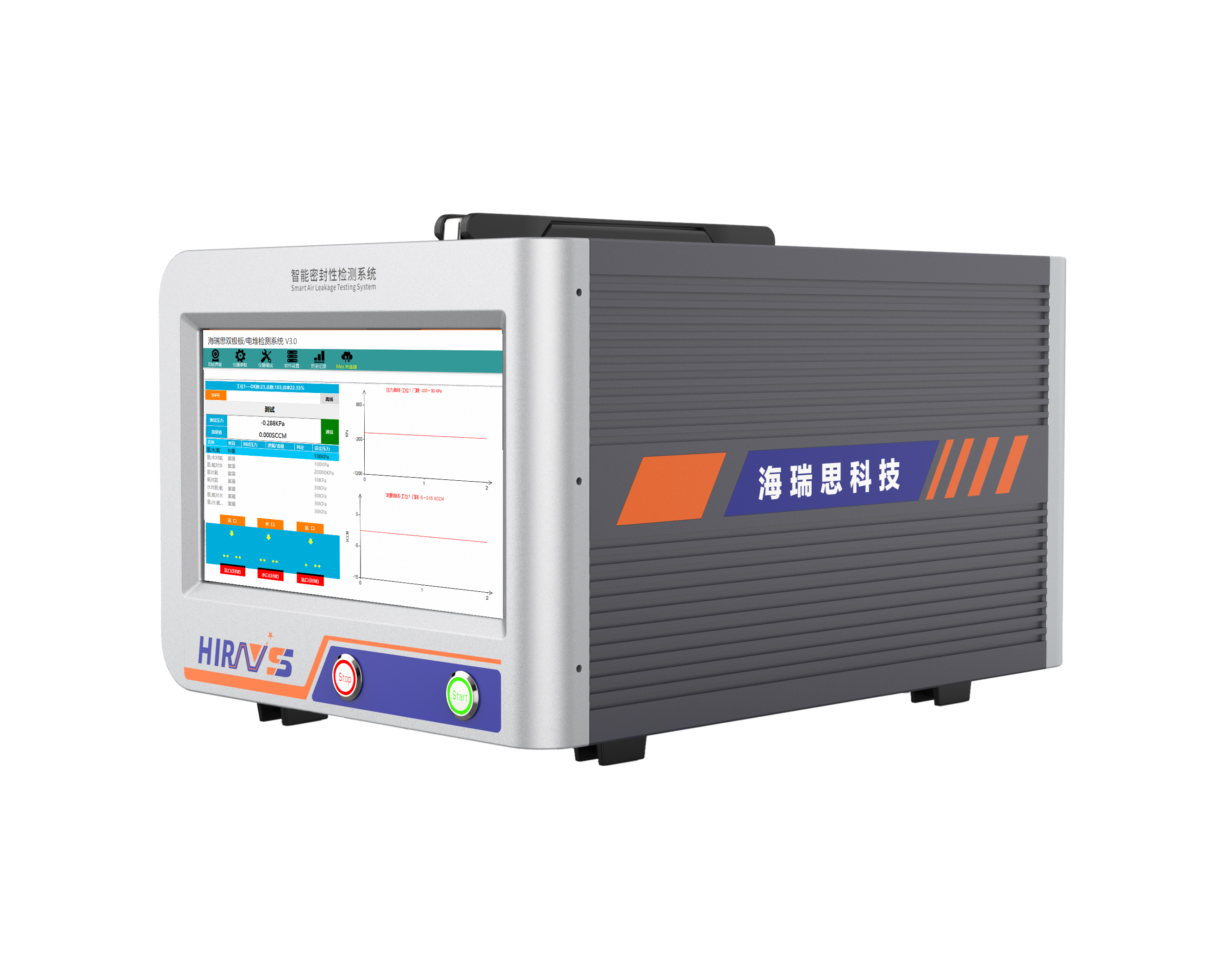
A helium mass spectrometer leak detector is a device that uses helium as a tracer gas to detect leaks through a mass spectrometer.After filling helium gas into the container under test, if there is a leak, the helium gas will escape and be detected by the mass spectrometer. By analyzing the helium gas concentration and flow rate, the location and size of the leak can be determined.
The advantage of the helium mass spectrometer leak detector is that it has high sensitivity and can detect extremely small leaks (as low as 10^-9 Pa·m3/s). It is suitable for high-precision and high-reliability air tightness testing and is widely used in aerospace, electronic packaging, nuclear industry and other fields.However, due to the high cost of helium gas, complex equipment operation and high maintenance requirements, the use cost of helium mass spectrometer leak detectors is high.
5. Negative pressure seal tester
The negative pressure seal tester is a method of checking the air tightness of the product under test by extracting air to form negative pressure.It is usually used to measure seals, pipe joints, air bags and other products that are sensitive to negative pressure.Its working principle is to apply negative pressure to the product under test and use sensors to detect changes in internal pressure. When there is a leak, the internal pressure of the product cannot remain stable.
The application range of negative pressure seal testers includes automobile manufacturing, home appliance production and packaging industries.Because its testing process is relatively simple and fast, and its testing accuracy is high, it is suitable for online testing in assembly line production.However, this device relies heavily on the accuracy and performance of the sensor, which requires regular calibration and maintenance.
6. Bubble leak detector
Bubble leak detector is a traditional method that uses soapy water or special foam agent to detect leak points.By applying foam agent to the surface of the object to be measured, when there is a leak, bubbles will form on the surface, thereby determining the location of the leak.
Bubble leak detectors are simple, easy to use, low-cost, and widely used in preliminary leak detection and maintenance inspections.However, this method has low accuracy and is suitable for the detection of larger leaks, but is not suitable for high-precision testing of small leaks.Foaming agent may cause contamination on the surface of some objects to be measured, so use it with caution.
in conclusion
Through the introduction of this article, we have learned about common air tightness testing equipment such as differential pressure tester, vacuum box tester, water intrusion tester, helium mass spectrometer leak detector, negative pressure seal tester and bubble leak detector.Different types of equipment have their own advantages and disadvantages in terms of testing principles, scope of application, and cost of use. Choosing appropriate air tightness testing equipment requires comprehensive consideration of the characteristics of the object being tested, test accuracy requirements, and cost budget.
Whether it is an application field with high precision requirements or testing on a mass production line, different air tightness testing equipment can meet specific testing needs.We hope that the introduction in this article can help readers better understand and choose appropriate air tightness testing equipment and improve product quality and safety.
-
2026.04.11Good News | Hirays Honored as "Most Investment-Worthy Enterprise" at 2026 AI Glasses China Tour
-
2026.04.11Why are more and more companies opting for RGA technology for power bank electrolyte leakage detection?
-
2026.03.30Commemorating the revolutionary martyrs and inheriting the red spirit | Record of hirays’s theme activity of walking to commemorate the martyrs’ cemetery
-
2026.03.20Starting from June, the sale of non-compliant power banks will be banned: many companies ignore this detection issue
-
2026.03.16After charging 70% in 5 minutes, how can the safety of the power battery be maintained?
-
2026.03.14Overcoming difficulties and showing responsibility, efficient delivery wins praise - a tribute to the four pioneer employees on the production front line
-
2026.03.03Comparison of mass spectrometry technology applications: How do Heris helium mass spectrometers and RGA series enable precision manufacturing?
-
2026.02.26Construction has started | hirays starts a new journey of struggle in 2026
-
2026.02.06Let’s work together to embark on a new journey | The 3rd hirays Fun Games was successfully held
